

Burnout & Stress Therapy in Toronto's Little Portugal
You know you should slow down. But you can't — and you can't seem to get motivated either.
Burnout doesn't always look like collapse. It can look like going through the motions at a job you used to care about, snapping at people you love over nothing, or getting through the day on caffeine and willpower with nothing left over by the evening. It's a body that's been running on "fine" for so long it's forgotten what anything else feels like.
A lot of people don't recognize it as burnout at all. They think of themselves as just busy, or in a rough patch, or someone who needs to "push through" — right up until pushing through stops working. For some people it's tied to one clear source: a job, a caregiving role, a specific season of life. For others, it's built up gradually from a dozen smaller things. Both are treatable.

Burnout or depression? It's not always obvious.
The two can look nearly identical: exhaustion, cynicism, trouble concentrating. Burnout is usually tied to a specific context (often work or caregiving) and tends to ease, at least somewhat, with real rest or a change in that context. Depression tends to follow you regardless of setting. They're not mutually exclusive — unaddressed burnout can turn into depression — and the exact label matters less than getting the right support either way.
What burnout and chronic stress can look like
✓Occupational burnout
Exhaustion, cynicism, and a drop in effectiveness tied specifically to work
✓Caregiver burnout
Driven by caring for a child, partner, or aging parent rather than a job
✓Chronic Stress
A nervous system that's been in low-grade "on" mode for so long it's stopped registering as stress at all
✓Compassion fatigue
Burnout specific to helping professions (healthcare, therapy, education, social work), where the exhaustion comes from constant exposure to others' distress
✓High-functioning Burnout
Still performing well on the outside while running on empty underneath, often the last to notice something's wrong
Whatever form it's taking for you, the through-line is the same: this is treatable, and rest alone usually isn't enough to fix it.
Here’s How to Connect

Fill out the form to schedule your free 20-minute intro call to explore how therapy can support you. We’ll help you get matched with the right therapist for you.
Email us with any questions you might have.
To book an appointment via JaneApp use the link below.
Reaching out is usually the hardest part. From here, things get simpler.
Fill out the form below and one of us will be in touch within one business day, usually the same day. No pressure, no commitment. Just a conversation.
Schedule Your Free Consultation

Book your free 20-minute intro call today. Schedule at your convenience.


Our team
Our team has deep experience working with clients who experience burnout and stress, both adults and teens. Whether you’re managing daily challenges or want a more comprehensive, structured roadmap, we’ll help you find the right path forward.


How therapy actually helps
Burnout tells you the answer is just to push harder, or that rest is a luxury you haven't earned yet. Neither is true, it's what a depleted nervous system does, not a reflection of your actual limits.
Sessions typically move between two kinds of work: practical tools for recovering capacity (boundaries, pacing, sleep, actual rest versus collapse), and slower work on what's underneath it — over-functioning, difficulty saying no, identity tied too closely to output. We also track progress with a standardized measure, so change is based on more than how a session felt.
We draw on a range of evidence-based approaches depending on what each person needs:

ACT (Acceptance & Commitment Therapy)
Reconnecting with what actually matters to you, separate from what you feel obligated to keep producing

CBT (Cognitive Behavioural Therapy)
Working with the thought patterns (perfectionism, guilt, all-or-nothing thinking) that keep burnout self-perpetuating

Somatic work
Burnout lives in a dysregulated nervous system, not just a tired mind, working with the body directly

Coaching-informed therapy
Practical boundary-setting, pacing, and workload negotiation
Mindfulness
Building the capacity to actually notice depletion before it becomes collapse

No one-size-fits-all
We'll work with you to develop a roadmap that meets your needs and goals — whether you're looking for practical tools and support, or want to better understand what's kept you overriding your own limits for this long.
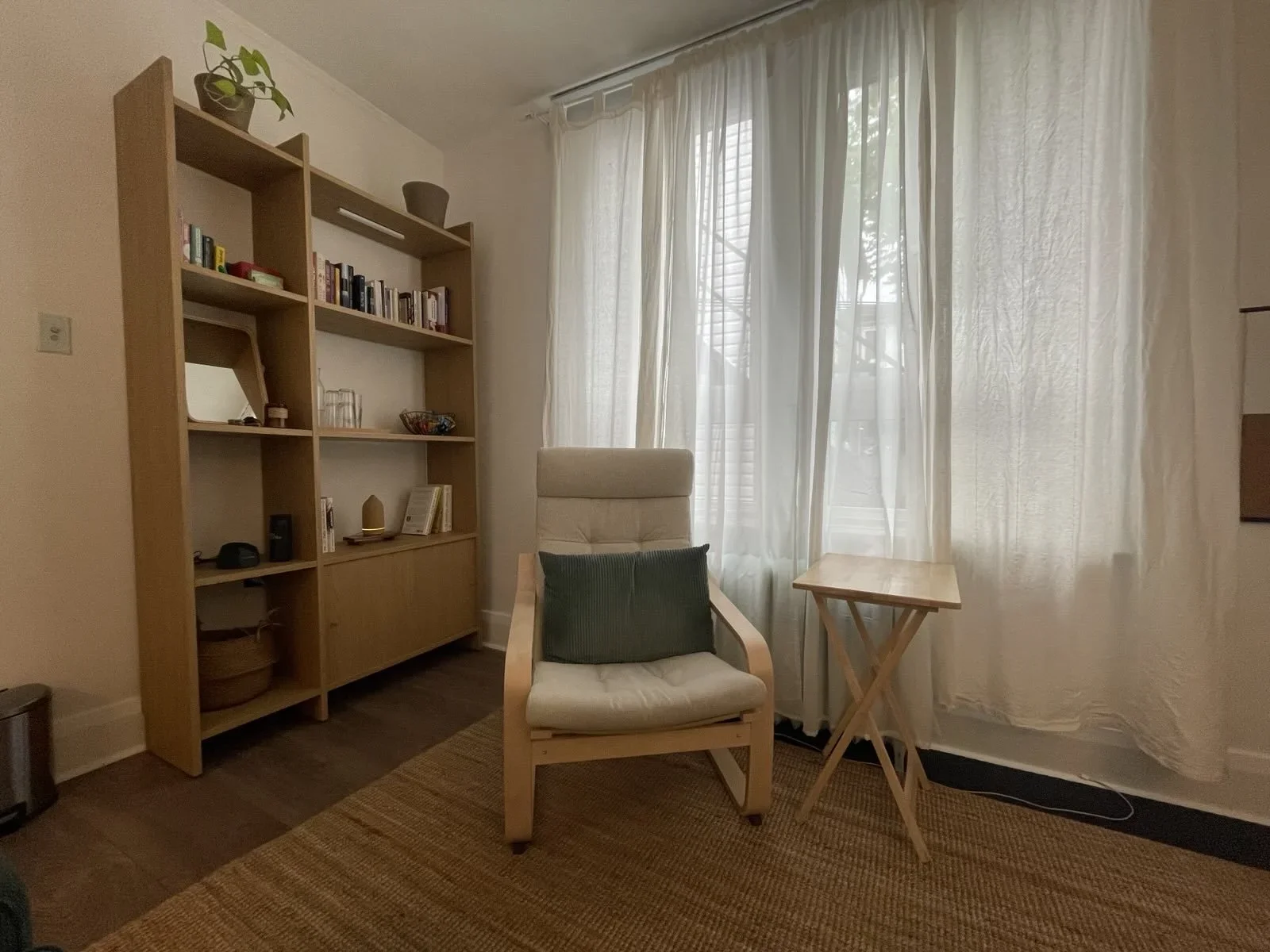
In person in Toronto's Little Portugal, or virtually anywhere in Ontario.

Burnout says you just need to push through. You don't.
Burnout responds well to therapy — not because therapy erases your workload or your responsibilities, but because it gives you the tools to build a sustainable relationship with both, instead of running on empty until something breaks.
You don't have to have hit a breaking point to get support. Catching it earlier is easier than recovering from collapse.
Before you begin
"I don't think I'm burned out enough to need help."
Burnout doesn't need to reach crisis level to be worth addressing. Catching it early is far easier than recovering after a full breakdown.

"If I just took a vacation, I'd be fine."
Rest helps, but burnout that's built up over months or years usually needs more than a break to resolve — otherwise it tends to return as soon as you're back.
"Everyone I know is just as burned out as me."
That may be true, and it doesn't make it sustainable. Shared exhaustion isn't the same as this being fine.
Who we work with
We support adults dealing with burnout and chronic stress — whether it's tied to work, caregiving, or a season of life that's asked more of you than you had to give.
In person in Toronto's Little Portugal, or online across Ontario.