
Depression Therapy in Toronto's Little Portugal
You're not alone. Depression is more common than most people realize.
Roughly 1 in 8 Canadians will meet the criteria for depression at some point in their life. Most of them will spend a long time before telling anyone, convinced they should be able to handle it, or that naming it makes it more real.
Depression doesn't always look like sadness. It can look like exhaustion that sleep doesn't fix, irritability, a fog that makes basic tasks take twice as long, or a flatness where things that used to matter just don't anymore. For some people there's a clear cause — grief, burnout, a relationship ending. For others it shows up with no obvious trigger at all. Neither version is a personal failure. Both are treatable.

Burnout or depression? It's not always obvious.
The two can look nearly identical — exhaustion, cynicism, trouble concentrating. Burnout is usually tied to a specific context (often work) and tends to ease, at least somewhat, with real rest or a change in that context. Depression tends to follow you regardless of setting. They're not mutually exclusive, in fact unaddressed burnout can turn into depression, and getting the distinction right matters less than getting the right support either way.
Depression doesn't look the same for everyone
"Depression" isn't one single experience. Some of the presentations we see most often:
✓ Major depressive disorder
The most familiar form: low mood, loss of interest, and other symptoms present most days for at least two weeks
✓ Persistent depressive disorder (dysthymia)
Lower-grade but longer-running, sometimes for years, often mistaken for "just how I am"
✓ Seasonal affective disorder (SAD)
Depression tied to seasonal light changes, typically worsening in fall and winter
✓ Perinatal and postpartum depression
Depression during pregnancy or in the year following birth, distinct from (and often confused with) the "baby blues"
✓ Situational or reactive depression
Triggered by a specific event or loss, but persisting well beyond what the circumstance alone would explain
✓ High-functioning depression
Meeting responsibilities on the outside while struggling significantly underneath, often going unnoticed by others (and sometimes by the person themselves) for a long time
Whatever form it's taking for you, the through-line is the same: this is treatable, and you don't have to already have the right label to start.
Here’s How to Connect

Fill out the form to schedule your free 20-minute intro call to explore how therapy can support you. We’ll help you get matched with the right therapist for you.
Email us with any questions you might have.
To book an appointment via JaneApp use the link below.

Book your free 20-minute intro call today. Schedule at your convenience.
Schedule Your Free Consultation
Reaching out is usually the hardest part. From here, things get simpler.
Fill out the form below and one of us will be in touch within one business day, usually the same day. No pressure, no commitment. Just a conversation.


Our team
Our team has deep experience working with clients who suffer from depression, both adults and teens. Whether you’re managing daily challenges or want a more comprehensive, structured roadmap, we’ll help you find the right path forward.

How therapy actually helps
Depression is convincing. It tells you nothing will change, that you're the only one struggling, that this is just who you are now. None of that is true — it's what depression does, not what's actually happening.
Sessions typically move between two kinds of work: practical tools that create fairly quick, tangible change (sleep, structure, thought patterns), and slower work on what's underneath — self-criticism, past experiences, relationship patterns. We also track progress and symptom improvement with evidence-based tools so progress is based on more than how a session felt.
We draw on the approaches with the strongest evidence behind them, matched to what's actually keeping you stuck:

ACT (Acceptance & Commitment Therapy)
Building toward what matters to you, without waiting to feel "ready" first

CBT (Cognitive Behavioural Therapy)
Understanding the thought patterns and behaviours that keep you stuck

DBT (Dialectical Behaviour Therapy)
For when emotion feels either shut off entirely or completely overwhelming

Somatic work
Depression lives in the body too, not just in thought patterns — working with the nervous system directly

EFT (Emotionally Focused Therapy)
For depression tangled up with relationship disconnection or attachment wounds
Mindfulness
Building a different relationship to low mood and numbness, instead of fighting or being ruled by it

No one-size-fits-all
Some sessions are practical — sleep, structure, getting back to the things that used to feel automatic. Others go deeper, into what's underneath the depression: self-criticism, unresolved grief, patterns in how you relate to yourself and other people. Neither replaces the other.
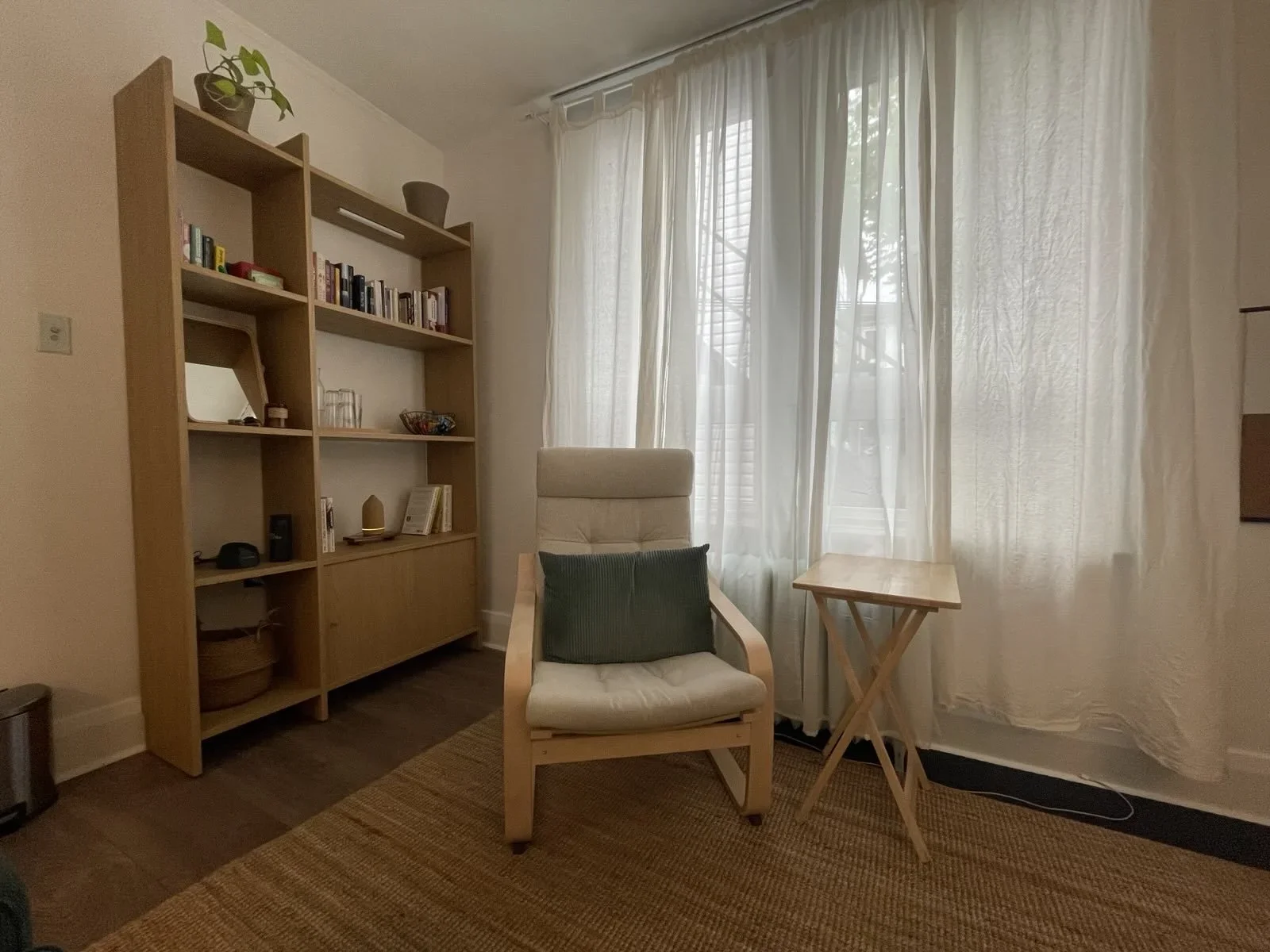
In person in Toronto's Little Portugal, or virtually anywhere in Ontario.
Depression says nothing can change. It's wrong.
Depression is one of the most well-researched conditions in psychotherapy, and one of the most responsive to it. Not because therapy erases the hard parts of life, but because it gives you back the tools and the insight to move through them instead of staying stuck in them.
You don't have to already believe it'll work. You just have to be willing to start.
Before you begin

"What if therapy doesn't work for me?"
Therapy isn't about being fixed — it's about understanding what's keeping you stuck and building real tools to shift it. No pressure to feel better on a timeline.
"I should be able to handle this on my own."
Needing support isn't a failure of willpower. You wouldn't expect to set a broken bone yourself — depression deserves the same seriousness.
"Talking about it won't change anything."
Therapy isn't just talking. It's identifying patterns, building skills, and making small, compounding changes, you don't need to fully believe in the process before starting it.

Who we work with
We support adults and teens with depression, whether that's a new diagnosis, a return of something you've dealt with before, or symptoms you haven't put a name to yet. Some people are looking for practical tools to get through day-to-day; others want to go deeper into what's underneath it. Both are part of the work.
In person in Toronto's Dundas West, or online across Ontario.